How many times have we heard someone say, "Music saved my life"? Usually this is meant in a broader or more figurative sense, but in one lucky fellow’s case, the meaning is quite literal.

According to CNN, a woman was able to save her husband’s life doing CPR to the music of a well-known disco song (‘Disco Tune Saves Man’s Life’). Thanks to a Public Service Announcement she had seen that recommended performing chest compressions to the rhythm of ‘Stayin’ Alive’ by the Bee Gees, Debra Bader successfully resuscitated her husband without the benefit of any prior CPR training.

This incident is such a powerful illustration of the ability that music and movement have to communicate things much better than words. Best practice in CPR is to perform chest compressions at approximately 100 beats per minute, but this means little to the average person. Because ‘Stayin’ Alive’ is such a well-known song (which, conveniently enough, moves at the exact optimal BPM for CPR) that most of us have danced to at some point in our lives, we are easily able to refer back to that muscle memory as a reference point for that speed.

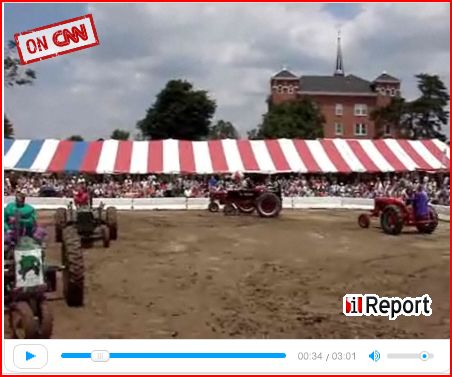
An alert iReporter caught this tractor square dance in Maria Stein, Ohio on tape. Not only is the sight of multiple John Deeres do-si-doing around each other all kinds of awesome, but also note how each one and its driver are decked out like superheroes. My vote goes to Wonder Woman.

tractorsquaredance

It was a sticky, humid day at the 2009 Smithsonian Folklife Festival, but this did not stop Puerto Rican bomba y plena musicians Viento de Agua from giving a dynamic performance that had the audience on its feet dancing.

Here is a video I made of Viento de Agua performing a plena. I did not catch the name of the song, so if anyone knows what it is, please comment. Plena is a traditional Puerto Rican style of music that we were told has its roots in the sound of a train. You can certainly here this underlying “chugging” sound in the music. Plena is one of the many caribbean styles that lends its rhythms and styles to salsa and merengue. It is characterized by the use of percussion instruments and vocal harmonies to form the rhythm and tune.

The second half of the 2009 Smithsonian Folklife Festival runs July 1-9 on the National Mall. The three featured themes this year are:

  • Giving Voice: The Power of Words in African American Culture
  • Wales/Cymru

and my personal favorite…

  • Las Americas: Un Mundo Musical / Music in Latino Culture

This dance craze is causing bodily harm to a number of enthusiastic young men in Jamaica. I can’t say I really feel sorry for them.

WordPress just keeps getting better. There is now a post by email feature which I am testing out this second. This is going to be useful in situations where there is a firewall or I just don’t feel like signing on to the website. Attached files will also post as well. I’m testing this out with a picture of cherry blossom time in DC.

p3312217

It doesn’t take a, uh, scientist to come to the conclusion stated in the title of this post. That said, it’s nice to have some quantitative evidence to support the significance of the live performing arts experience.

The NYT’s Tierney Lab blog posts about a study conducted in conjunction with the Dance Your PhD contest (in which scientific studies are interpreted through dance).  Live audience members were given the four finalists’ abstracts and had to guess which dance matched up to which study. The same challenge was given to the online readers of Gonzo Scientist. The data were analyzed and the results are discussed here.

The most compelling finding of the study is that the live audiences did much better at correctly matching the study topic to the dance. As John Bohannon, the study’s author and Gonzo Scientist blogger, says, it is true that many in the live audience had a dance background as well as worked in the sciences.

“But it doesn’t solve the mystery of why live audiences seem to be smarter in general. It’s unlikely that the online experiment systematically attracted people with less science or dance expertise. Nor is access to information likely to make the difference. (Probably few online participants took the time to read the full papers.)

I propose a simple explanation. Being part of a live audience focuses your attention in a way that staring at a lonely computer screen never can. It’s equally true of art and science.” [emphasis added]

Google Labs keeps me entertained with its constant flow of new ideas. The newest one to catch my eye is Similar Images. It works like google images, but rather than relying on keywords to find what you need, once you find an image that approaches what you’re looking for, this app will find ones from around the internet that contain similar attributes.

This is what the front page looks like. Let’s try a search for my favorite subject, dance.

similar images front page

A variety of different results come up. Let’s say I’m looking for a dramatic photo of dancers mid-air against a stark background (as seems to be the fashion these days). We clock on the “similar images” link under that picture…

similar images dance search

Et voila`, lots of mid-air dancers on stark backgrounds.

similar images dance search refined

I can think of so many applications for this labs creation, particularly for bloggers like me who are looking for just the right image to accompany their posts. While the example I show above only resulted in dancers (though in one case it was not a photo but a drawing, which is neat too), I clicked through to other results that did not contain dancers but similar colors, backgrounds, and configurations of images. This could be a positive or a negative depending on what you’re looking for, but nonetheless it’s a new toy to play around with.

Although the Wolf Trap is only a few miles from my home, save chaperoning a bunch of screaming kids at the International Children’s Festival, I am ashamed to say that I have never attended an even there. After spotting their summer ‘09 calendar and the fabulous goodies on it (not limited to dance), that will hopefully all change. This summer’s dance lineup at Wolf Trap includes the following highlights:

  • Rasta Thomas’ Bad Boys of Dance on June 16
  • Aspen Santa Fe Ballet on July 7
  • Merce Cunningham on July 14
  • 42nd Street runs July 17-19
  • Trey McIntire Project’s Face of America: Glacier National Park on August 19

This and much much more can be found on the Wolf Trap Site. The recession is not excuse– the lawn seats are the cheaper– and more relaxing– way to go. So grap a picnic basket, a blanket, and enjoy some arts under the stars this summer!

I don’t know if it’s too much yoga and not enough dance, but I can’t seem to find the inspiration to write much lately. Personal blogs are interesting that way; they do tend to come and go, ebb and flow with the whims of the writer. Similarly, my blogroll changes as blogs I follow change or fall into inactivity. Not that I’ve been reading many blogs lately either. But here are a few that I enjoy following lately.

Apartment Therapy – If you live in a small space like me, those lavish spreads in traditional design magazines and blogs are hard to relate to. Apartment Therapy is a blog/web magazine that gives inspiration to those of us who don’t want to sacrifice style in tight quarters. From inspiring color schemes to unique ways to jazz up an entryway (or the wall by your door if you don’t technically have an “entryway”), I have gotten many ideas from this blog that I’ve been able to apply to my own living space.

This is Why You’re Fat - Only in America… Bacon, deep frying, and food-on-a-stick feature prominently on this blog of all culinary creations obscene. Yes, it’s an offensive name, but let’s face it– if you ate stuff like this on a regular basis, I don’t see how you could be skinny (or healthy).  I dare you to look through such creations as The Bacone (A bacon cone filled with scrambled eggs and country gravy topped with a biscuit) or the Fat Sam (Cheesesteak sandwich with chicken fingers, french fries, mozzarella sticks, ketchup, lettuce, tomato, bacon, and topped with egg and hot sauce) without giggling just a little bit.

Jodi’s Blog – I always enjoy following my friend, the talented artist Jodi Hoover’s blog. But never have I enjoyed it more than in the last few days as she blogs The World Beard and Moustache Championships. Jodi’s husband Mickey proudly represented Maryland with his full face of hair. I can’t tell you how entertained I have been reading about the Parade of Beards, and the politics of the World Beard and Moustache Association, and The Beards, an Australian band that, as Jodi explains, “They sing songs about beards for people with beards.”

On Friday I reach the end of 40 Days to Personal Revolution, the yoga program that has been a big part of my life for the past 6 weeks (read all about it here). As I come out of this incredible experience, I reflect on how I will move forward from here.

The “revolution” part of the 40 days was not what I thought it would be. Basically, I’d had this vague idea that I would lose a lot of weight and get totally buff, all while becoming a more chilled out person in the process– pretty much in that order. As for the weight, I haven’t lost any. Not one pound. Not one-half of a pound. As for the buffness, I am happy to report that this expectation has come to fruition. I have some pretty nice tone and defininition around my shoulders, upper arms, and back that I have never had before. And if I poke my finger through the thick layer of fat on my derriere, there’s a nice solid gluteus maximus in there.

As for the chill factor, that two has happened, but in much more specific ways than I could have ever predicted. Having a new relaxation and centering tool (meditation) is a great new tool in my arsenal for getting through difficult moments or fending off anxiety. On a more global level, my priorities have shifted a little. I no longer feel like I have to do it all. If  I miss out on something ‘extra’ in favor of spending time chatting with a friend, visiting family, or just relaxing with a book or enjoying the weather outside, so be it. I see the benefit of not being so overscheduled and I appreciate that taking time to enjoy these little, yet most important things in life, enrich my life much more than that extra class or workshop or seminar or networking event ever could.

As I come out of the program, I will come back to dance. But things will be different. I will continue to do yoga more frequently (probably 3-4 days a week rather than the 6 I have been doing), while gradually re-integrating dance into my life. I will probably pick up a little on the blogging, but I will not feel pressure to write any more often than comes naturally to me. This blog is not a means to an end. It is simply an outlet for me to process and share the thoughts and joys that dance brings to me. Rather than “moving on” with my life, I am simply moving forward, taking with me the additional gifts I have been given.

In honor of wordpress enabling the embedding of TED videos, here are some amazing moves from Kenichi Ebina, a guy who has no skeleton.

I have taken a brief sabbatical from dance. Earlier this spring, I decided that it was time to get my life into greater balance. At the beginning of the year, I committed to taking better care of myself and to slowing down a little. So the timing was perfect when my yoga studio opened registration for 40 Days to Personal Revolution, a program created by Baron Baptiste (of Baptiste Power Vinyasa Yoga, the style that I practice).

I consulted Mr. P and some close friends to see if I was crazy to consider doing yoga for 40 days straight. Everyone seemed to think it was a good idea as long as I was willing to making it a priority in my life. I would have to step back from a lot of my usual pastimes and commitments for the duration of the program. The more I thought about it, the more excited I got about it, so I registered away. I told my family and friends I was going to do it, and increased the frequency of my yoga practices to gear up for it.

Then, on what was supposed to be day 1, I got a call from the studio: only five people had registered for the program, not enough to go through with it, and they were rescheduling it to early summer. Did I want to go ahead and wait, or just get my money back? I was crestfallen. I had been so excited about doing this, and was incredibly committed to seeing it through; there was no telling where my life would be in two months. After sleeping on an idea from Mr. P I called the studio and asked them if I could still have the discounted rate on the unlimited yoga classes and do the program on my own (which they agreed to). Yay me!

The way the program works (I am following Baptiste’s book to structure the program as I do it solo) is you do yoga six days a week with one day off. You meditate every day, journal,  and bring more balance into your diet. I had never meditated before, and luckily you start off gradually, with just five minutes the first week, and working up to thirty in five minute increments by the sixth and final week. The diet portion is not too prescriptive, with just a page or two each week reminding you to incorporate more fruits, veggies and whole ingredients into your diet. Nothing too “out there,” save the three-day fruit fast in week four (more on that later).

So here I am on day 24– how am I faring? Read the rest of this entry »

The NYT’s ArtsBeat Blog asked artists to comment on how the recession is affecting them. It is a fascinating read.

Common themes:

  • Artists are poor to begin with so they didn’t have much to lose.
  • Recessions are good for lesser known artists because the focus on high-priced works produced for rich patrons has decreased. People buy what they can afford and artists produce less for the sake of pandering.
  • For-profit creative industries (i.e., graphic designers, vs independent artists) are being hurt the most.
  • Those that have a day job are counting their blessings.
  • The NYT Arts Beat Blog is a great place for self promotion (just look at all the website links and full names people signed their comments with).
credit: J-Rad, flickr

credit: J-Rad, flickr

Now I want to know from you: How is the recession affecting dance? The economic impact on companies is evident, but how is the down turn affecting the creative process?

My dear regular readers, you may be asking, “Speaking of the recession, what’s up with your blog? does the lack of posts in the last bunch of weeks mean you’re being affected by the downturn as well?” First of all, we are a volunteer operation here so nope, no impact. If I were unemployed, you can bet I’d be posting a lot more! There are two factors at play:

  • I am grateful for my secure job and perhaps because of that– and an increased workload– have been spending more time and effort on it.
  • I am participating in a 40 day yoga program (today is day 24), so I’ve been dancing very little. I’m halfway done with a post about the experience, so stay tuned!

It’s nice to know we have had so many dance movies in the past few years that it is time for a parody:

Preview for Dance Flick

Tonight I took a master class with a dancer from the Bill T Jones/Arnie Zane Dance Company at the Kennedy Center. The Kennedy Center has started offering these master classes just this year and it is really a wonderful opportunity to learn technique from some of the most influential dancers today.

The ticket said the class would take place in the rehearsal hall, where I had never been before. As I entered the Kennedy Center from the shuttle bus area, there was a small table set up with a woman taking tickets. We were instructed to wait there until we were escorted up to the rehearsal hall. We were taken through a back hallway and up several floors in a freight elevator. Then we wound our way through a warren of cramped, windowless cubicles (the idea of working at the KC doesn’t seem that cool anymore after seeing the working conditions), before coming upon a moderate sized dance studio. It was interesting to get a chance to see the bowels of the KC.

The class was taught by a woman named Leah from the company. We started out with a floor sequence before moving on to standing warmup combinations and finishing with some choreography from a new piece the company is working on. As with any new instructor or style, I had to constantly remind myself during the course of the class to keep and open mind and be patient with myself. It can be frustrating to move in a way that is not familiar or to memorize new combinations when it does not feel natural. In the end, things did click for me and I came away from the class with some new insights.

Leah talked about Jones’ approach as task based movement. It took me the whole class, plus a conversation with Leah after class to fully grasp what this means. Essentially, task based movement is about fully describing a movement, rather than just showing it or giving it a shorthand name. This allows the dancer to embody and put thought into each moment of the movement. The word precisionwas used quite a bit, but in the context of task based movement, this means more how you do something than exactly how it should look. One example of this was the directive to swing the right leg up and make contact at three points– each hand with the ankle. How high the leg was or the line of the leg was of less consequence than the sequence of movement, where you’re going, and what you have to do to get there. As we repeated the combination, we were constantly exhorted to thing about the process of completing each movement task. After many repetitions, the list of tasks became less of a burden and more of a guide. Another “script” we were given was to sing during one of the standing warmups (a tendu/degage sequence). We were to make up our own rhythmic tune to hum as we went through the sequence. This did help me get out of my head and feel more at one with the pattern.

I am able to see applications of task based movement for my own dancing as a tool for picking up choreography (something I am not very good at) more quickly. Creating a running narrative, rather than relying on muscle memory or my mediocre knowledge of ballet vocabulary, creates an additional script to guide the reproduction of a sequence.

The choreography itself was enjoyable to do. The quality of the movement felt natural, employing a lot of the momentum and catch/release we do in Helanius’ class.

Tweets

Error: Twitter did not respond. Please wait a few minutes and refresh this page.

Archives

Blog Stats

  • 85,422 hits